 The three members Bench of Justice D.V. Sharma, Justice S.U. Khan and Justice S. Agarwal has ruled by a 2-1 majority that all the parties in the title suit, i.e. Bhagwan Shree Ram Lalla represented by his sakha (close friend) Triloki Nath Pandey, the Nirmohi Akhara and the Sunni Waqf Board will have one third equal share each of the disputed property and declared the litigants joint title-holders. Justice Sharma has disagreed with the decision of the majority that one-third of the disputed land should be given to Muslims for construction of a mosque. Dismissing the suit filed by the Sunni Waqf Board for a declaration and possession of the site so that Muslims can rebuild the demolished mosque on the same spot, the Bench has allotted the portion right below the central dome of the demolished Babri Masjid to Bhagwan Shree Ram Lalla Virajman with a caution that the defendants should not obstruct or interfere the area in any manner. The areas covered by the structures of Ram Chabutra, Sita Rasoi and Bhandar in the outer courtyard were allotted to the Nirmohi Akhara. The two Hindu litigants will share the remaining unbuilt area within the outer courtyard “since it has been generally used by the Hindu people for worship at both places.” The Bench has allotted the rest of the area where the Babri Masjid stood, including part of the inner courtyard and if necessary also some part of the outer courtyard to the Waqf Board stating that “the share of Muslim parties shall not be less than one third (1/3) of the total area of the premises”. To alleviate the progress of such a three-way division, the Bench has advised to use some parts around the disputed land presently under acquisition of the Government of India. The judges also ordered that the prevailing status quo which is currently under state control shall be maintained for a period of three months.
Showing posts with label Communalism. Show all posts
Showing posts with label Communalism. Show all posts
Monday, October 25, 2010
Ayodhya verdict & our secular conscience: Part Two
The three members Bench of Justice D.V. Sharma, Justice S.U. Khan and Justice S. Agarwal has ruled by a 2-1 majority that all the parties in the title suit, i.e. Bhagwan Shree Ram Lalla represented by his sakha (close friend) Triloki Nath Pandey, the Nirmohi Akhara and the Sunni Waqf Board will have one third equal share each of the disputed property and declared the litigants joint title-holders. Justice Sharma has disagreed with the decision of the majority that one-third of the disputed land should be given to Muslims for construction of a mosque. Dismissing the suit filed by the Sunni Waqf Board for a declaration and possession of the site so that Muslims can rebuild the demolished mosque on the same spot, the Bench has allotted the portion right below the central dome of the demolished Babri Masjid to Bhagwan Shree Ram Lalla Virajman with a caution that the defendants should not obstruct or interfere the area in any manner. The areas covered by the structures of Ram Chabutra, Sita Rasoi and Bhandar in the outer courtyard were allotted to the Nirmohi Akhara. The two Hindu litigants will share the remaining unbuilt area within the outer courtyard “since it has been generally used by the Hindu people for worship at both places.” The Bench has allotted the rest of the area where the Babri Masjid stood, including part of the inner courtyard and if necessary also some part of the outer courtyard to the Waqf Board stating that “the share of Muslim parties shall not be less than one third (1/3) of the total area of the premises”. To alleviate the progress of such a three-way division, the Bench has advised to use some parts around the disputed land presently under acquisition of the Government of India. The judges also ordered that the prevailing status quo which is currently under state control shall be maintained for a period of three months.

Thursday, October 21, 2010
Ayodhya verdict & our secular conscience: Part One
 In a large and diverse country like India, there is never a dearth of issues that stimulate the citizens to talk, argue and fight. But the credulous public mind, overexposed and debilitated by artificial trends and a plethora of confusing information are often been hypnotized by the shining pendant of a forged present and a delusional future. Moreover, a vague vision of history compels them to acquire comfort by mirroring a general trend of forgetfulness. In this spurious atmosphere, even a detrimental agenda can easily capture public imagination and receive popular support. Incapable to ponder much of its gravity, people tend to offer themselves as cannon fodder in socio-political conflicts waged against their own interests. The six-decade-old Ayodhya dispute over the ownership of 2.77 acres of “holy” land is such a thorny issue that has sharply polarized a devout Indian society along quasi-religious lines. Flaring up from time to time, the dispute has instilled a stream of dangerous ideas deep inside the country’s psyche. Acknowledged as one of India’s most divisive and contentious issues, the dispute with its high hegemonic potential has shaken the very foundation of the country’s collective identity as a nation and gradually grown into a symbol of subjectivity. Looking into the chronology of events including the wide network of relations and sectoral interests in and by which the dispute is situated and sustained for such a long time will provide us a necessary linkage to the Ayodhya verdict which was recently delivered by the Lucknow Bench of the Allahabad High Court.
Sunday, April 12, 2009
Towards a secular pro-people alternative?
 The emergence of a third alternative has raised some serious doubts in the mind of the Indian electorate. Theoretically, the concept of a third alternative is exciting as it has the potential to be more consensus-based and apparently is capable of reflecting the alternative opinion of the electorate in a healthier way. But in practice the idea is underlined by skeptical connotations. The main cause behind this doubt is derived from the historical experiences of similar non-Congress, non-BJP formations of the past. Whenever there was a post-election positive atmosphere generated by political conditions for an alternative force, most of the efforts had failed to deliver in accordance to the public expectations due to the diverse political objectives of the consequent political parties. For many of the constituents, the formation of a ‘Third Front’ was envisaged purely in mere electoral terms, keeping in mind their restricted political equations. These political parties, many of them with strong regional perspectives usually come together in a situation of electoral compulsions but soon enough, due to their conflicting ambitions, prefer to roll back into their respective regional agenda. The lack of common vision and objectives between the constituents quickly move towards internal differences, political and personal rivalry between the leaders sprung up in the most deplorable manner which ultimately compels the formation towards its untimely collapse. Instead of sustaining its significance as a robust force, the ‘Third Front’ formations of the past, on the contrary, have strengthened the Congress and the BJP and both the parties has immensely benefited by the ‘failed experiments’ of the formations. But in spite of this fact, one cannot deny that the experiments had its crucial significances also. Whether we like it or not, it has definitely strengthened the Indian democracy by facilitating the progress of smaller parties to grow important in national politics.
 Stability of a future government is one of the prime criteria to the electorates while they cast their votes. There is a deep reservation in the mind of the Indian electorates about the third force concept as all similar non-Congress, non-BJP governments in the past have failed to complete their full term. Therefore, it is not surprising to find that the Indian electorate is not too much enthusiastic about the third alternative formation. They are asking – is the alternative capable to provide stability? Will it be possible for them to keep aside their conflicting ambitions to enforce pro-people policies and effectively keep the communal forces at bay? At a time of unprecedented global economic crisis, will it be possible for them to co-opt an effective economic policy which will protect the jobs and livelihood of millions of common people and at the same time encourage the economy to prosper? All these are pertinent questions which need to be convincingly addressed.
The Left is presently playing a key role in giving shape to another pragmatic concept of a third alternative in the 2009 General Elections. They have specified that their aim is to put up a non-Congress, non-BJP choice in front of the electorates and to provide an alternative platform for the people, who do not want to support either the Congress or the BJP. They have laid emphasis on the need for alternate pro-people social and economic reforms and an independent, non-aligned foreign policy which will be qualitatively different from the policies which the two largest national parties have a tendency to follow. According to the CPI(M) general secretary Mr. Prakash Karat, “…democratic and secular forces who can agree with the Left on pro-people economic policies, on social justice measures, and an independent foreign policy” will join hand for this proposed formation. The Left has primarily achieved some vital success during the build-up process of the third alternative. Some regional parties spread across various states of the country, smaller but important in electoral terms, have already agreed to be part of this formation. The prospect that more parties associated with both the BJP led NDA (National Democratic Alliance) and the Congress led UPA (United Progressive Alliance) are likely to join the new formation has also brightened. The Congress and BJP both has initially tried to ignore this formation but in the manner both are mocking the formation and aggressively attacking it with their selective rhetoric in various election rallies is a clear indication that they are growing more and more tensed. The prime reason behind their anxiousness is due to the lack of any major election issue this time. The possibility to win the mind of the Indian voters has therefore become dim and both the Congress and the BJP is finding great difficulty to build-up public support around themselves.
In this scenario, the regional political forces will gain momentum and will certainly play a prominent role in the national level of politics. The possibility that the Congress and the BJP might lose significant ground in the hands of their principal regional opponents in respective states is growing stronger. Also when too many parties are knocking against each other for a limited space, the situation becomes more complicated for the large national parties to deal with. The important fact that both of them have a very limited presence in some of the key big states of the country which contribute close to 50 per cent of the total seats in the Indian Parliament is hard to ignore. This is also the reason why many of the present NDA-UPA allies are keeping their intentions obscure and maintaining a fluid state to reconsider all sorts of possibilities that are likely to emerge after the polls. Even crucial regional parties like the Bahujan Samaj Party (BSP) while showing interest about a non-Congress, non-BJP alternative have declined to be part of any pre-poll alliance.
The concept of a third alternative is significantly different from the concept of a ‘Third Front’. It should be noted that the Communist Party of India (Marxist) which is playing a pivotal role in giving shape to this ‘viable, credible and sustainable electoral alternative’ has never called this formation a ‘Third Front’ but mentioned it as a non-Congress, non-BJP alternative. The term Third Front is actually a misinterpretation of the media. While clarifying the concept, the party has said that it does not conceptualize this third alternative purely in electoral terms but as a force ‘forged on the basis of people’s sustained struggles and movements’. Instead of confining itself to political manoeuvring and electoral bargaining, the desired objective of the party is to contribute to a progressive shift in Indian politics through joint popular struggles on a pro-people agenda built around the two basic issues – opposition to communalism and anti-people economic policies of the Congress and the BJP. The CPI(M) also perceives that opposing anti-people economic policies also means taking a principled anti-imperialist position that will uphold the sovereignty of India in foreign policy issues. Regional secular parties, those who reflect the discontent of common people against the anti-people economic policies will be forced to join this third alternative because they will eventually feel the pressure from their own social base as the living conditions of the masses is deteriorating further and further.
There is really no significant differences in the liberalization and privatization policies of the Congress and the BJP. The successive NDA and UPA regimes both have subscribed to liberalism friendly policies and encouraged rampant privatization in significant social sectors like health and education. Low state spending and reduction of subsidies for agriculture sector has intensified the agrarian crisis and consequently led to more and more farmer suicides not only in Maharashtra but also in Karnataka, Andhra Pradesh and Chhattisgarh. During the UPA rule, the Left ‘intrusion’ has safeguarded the banking sector from the impact of the global economic crisis, the insurance sector from foreign direct investment and helped to protect many other public sector industries from the disinvestment policy of the Government. Its continuous pressure on the Government has also forced it to approve the Rural Employment Guarantee Act and the Forest Tribal Bill. The Congress led UPA has also struck a strategic alliance with the United State through the military collaboration agreement which is an unprecedented shift from India’s sovereign foreign policy. But the manner in which the Congress led UPA went after the dubious Indo-US nuclear deal which the Left has been opposing from the beginning has greatly disillusioned them about the Congress.
The Congress led UPA has failed to address the alarming price rise of essential commodities including the price of drugs and medicines. This has severely affected the lives of the population who belongs to the lower level of the socio-economic stratum. The economic policies of UPA were targeted towards favoring big businesses and as a result have widened the social divide in the country. The urban and rural rich have reaped the maximum benefits of the so called ‘development’ and at the same time the vast majority has sunk to a greater extent into poverty and hunger. It is bizarre that in a country where 230 million people are undernourished, 40 per cent of children less than three years of age are underweight, 77 per cent of the population spends less than Rs. 20 a day and 39 per cent of adult population is illiterate – four out of the ten richest people in the world are Indians! Who are actually benefiting from the four years of ‘consecutive economic growth’ in GDP till 2008 is evident from these facts.
In the absence of any major election issue, the BJP has returned to its nucleus – pulling out the Hindutva agenda from their closet. Obviously, a leopard cannot shed its spots. By raising the Ram temple and Ram Setu issue and boasting to replicate the Gujarat model, BJP is hoping to stir up a viable and effective election wave that might pave the way for L.K. Advani to occupy the Prime Minister’s seat. In the recent years, communal forces have continued with their vicious and divisive activities under the political umbrella of the BJP. The party continues to cover nefarious elements like the Vishwa Hindu Parishad and the Bajrang Dal, those who has perpetrated violent attacks on Muslim and Christian minorities in Orissa, Karnataka, Madhya Pradesh, Gujarat, Rajashtan and Chhattisgarh. The recent Barun Gandhi episode is a ringing proof of this nakedly divisive politics of the BJP. It stands for the most reactionary forces of India and keeps on communalizing the terrorism issue by attributing all terrorist activities to the Muslim community of this country. The party’s hypocritical stand on the Malegaon blasts case where Hindutva extremists were arrested for perpetrating the heinous crime has brought out the diabolical disposition of the BJP in the open. The BJP is essentially a regressive force that seeks to pass off majority communalism as ‘nationalism’ and represents a ‘distilled communalism’ in all aspects of their agenda. Instead of involving the common masses to build up a powerful and unified alternative force against this communalism menace, the Congress has deliberately preferred to take a soft and safer stand in the BJP ruled states where they are the chief opposition party. In a state like Gujarat, it has even taken the path of soft Hindutva – just for electoral gains.
There are predictions that the Left will be unable to sustain its strength of 60 MPs in this election. The lack of any major national election issue possibly will also adversely affect the Left’s prospects in Bengal and Kerala. Though it is early to comment on how much the Left will loose their grounds, one thing is certain. Even if it looses ground, the loss will be replenished by the third alternative allies including the Bahujan Samaj Party (BSP) which will help them to remain important in national politics. This specific aspect has ringed alarm bells to the Congress and BJP. Both the parties are not only worried about their incapability to win enough seats to be in command of any future coalition, the sturdy presence of an ideology bound Left force is always viewed as a spoiler by them. In whichever form it might ultimately shape-up, the significance of the third alternative lies here.
Image courtesy: picasaweb.google.com
Sunday, February 15, 2009
The Lifetime Achievement of L. K. Advani
 Lal Krishna Advani, the Prime Ministerial candidate of the Bharatiya Janata Party (BJP) is generally believed to be a Hindu hardliner politician largely liable for polarizing India on communal lines. Leaving behind trails of blood and communal passions, his infamous Rath Yatra had created a sort of hysterical upsurge of the Hindutva forces during the Ram Janmbhoomi movement that lead to the eventual demolition of the Babri Masjid. His Rath Yatra is also credited to be the pivotal force behind the speedy and almost smooth rise of BJP as an alternative of the Congress Party in different parts of the country. Advani believes that the shrewd construction of the Hindutva hysteria is one of his most important contributions to the country and its people. Though the Hindutva card along with its chief architect has apparently lost its original shine and luster, the revered television media group New Delhi Television (NDTV) has considered giving him a face-lift by bestowing a Lifetime Achievement Award in their fourth ‘Indian of the Year’ award ceremony this year (see video here). Keeping aside NDTV founder and chairman Dr. Prannoy Roy, the juries of the award selection committee comprising Fali Nariman, Shashi Tharoor, Anu Agha, Rahul Bajaj, Harsha Bhogle and William Dalrymple reportedly did not select Advani. They were actually unaware that such an award was going to be bestowed on Advani in the function. According to the media watchdog Hoot, two of the juries were uncomfortable about the choice and particularly one among them later said that ‘he would not want to be associated with any award which gave prizes to communal hatemongers.’ Clarifying the selection process, Prannoy Roy later said that NDTV always reserves the right for its editors to select and present one or more non-jury awards. This clarification made it crystal clear that Advani’s selection was done by none other but entirely by the NDTV coterie.
 Founded on 1988, NDTV started out with just one weekly programme called The World This Week in the state owned Doordarshan channel. Later in 1998, it bagged the ‘prestigious’ contract to produce a 24-hour news channel for Rupert Murdoch's Star Network. Today it is the largest independent private television production house in India. Its flagship news channel NDTV 24x7 holds the biggest market share among English news channels in the country. It is the only Indian channel which broadcasts in Pakistan, has launched a 24 hour NDTV Arabia for Middle East and North Africa and broadcast programs in Sri Lanka, Bangladesh, Maldives, Nepal, Middle East, Mauritius, South Africa, Europe, US, Canada & New Zealand.
In the year 2002, NDTV (then the producer of Star News) had invited the ire of Hindutva forces particularly for its coverage of the Gujarat riots. Though widely credited for airing un-biased, courageous, insightful, and comprehensive news that had unmasked the State Government’s role in the pogrom, Star News was severely criticized for ‘indulgence in gossip’, for insisting that the Army’s deployment was unduly delayed during the riots and for interviewing the Ahmedabad police commissioner in an ‘arrogant and hectoring tone’. The channel “carried some graphic footage and interviews in the thick of the riots – in Ahmedabad and along the Vadodara-Godhra highway where a number of industrial establishments and trucks were burnt” and also broadcasted an extremely moving interview with the intrepid activist of communal harmony Professor J.S Bandukwala – whose house was attacked and torched by vicious Hindu mob in Vadodara during the riots. Star’s behind the news stories by correspondence Shikha Trivedi portrayed the “trauma and alienation of the Muslim communities and individuals who returned to their villages on sufferance, and in the ways in which tribal communities have been co-opted into the Hindutva fold”. (Subarno Chattarji: Media representations of the Kargil War and the Gujarat riots, Sarai Reader 2004) Obviously, pro-Hindu outfits and under the cloak communalists from the affluent middle class harshly condemned the coverage as biased and ‘full of white lies’. Its ace reporter Barkha Dutt’s car was surrounded on a Gujarat highway by fanatics armed with swords and asked “what’s your religion?” NDTV crew had to cry ‘Jai Sri Ram’ before their vehicles were allowed to move. (Editors Guild Fact Finding Mission Report on Gujarat Riot, May 3, 2002) Barkha Dutt’s reporting on a violence hit 90 km rural stretch where not even a single police constable was found to be present infuriated the authorities at Gandhinagar and New Delhi. Accordingly, orders were issued by the Gujarat government to district headquarters to block the Star News channel. On March 2 the channel was blocked for several hours. Lal Krishna Advani was then the home minister of the country. The coverage of Star News was termed by his party as ‘pseudo secular’.
It is therefore almost bizarre to see that the same NDTV which in 2002 had helped to expose the Gujarat pogrom perpetrated by Hindutva fanatics under a fully supportive state BJP government and a partly supportive NDA government at the center is honoring the ‘one and only’ Advani in 2009 with a Lifetime Achievement Award for his work in the field of politics! What would have changed in these seven years that obliged NDTV to hand over the award to Advani is a perplexing question to answer. One of the supposed reasons is that the award was bestowed to Advani to make sure that he attends the award ceremony. But this cannot be the only reason.
After receiving the honor, the ‘intelligent, thinking and unpredictable’ Advani (as Prannoy Roy has described him) said that “One of my positive experience, which many in the country seem to see as a negative, was my Rath Yatra from Somnath to Ayodhya. I really think that by that Rath Yatra, I was able to convert the nature of the debate that was taking place before those years, which was that my party is communal and other parties are secular. I just converted the debate to genuine secularism versus pseudo secularism.”
Public memory is short and needs to be refreshed time after time. From NDTV’s award ceremony dais Advani was in fact bloating about his original Rath Yatra of 1990 that began from September 23 to ‘unite Hindus’ on an anti-Muslim agenda. The decision to launch the Rath Yatra was Advani’s anxious response to the threat of the then Prime Minister V. P. Singh’s decision to implement the Mandal Commission recommendations and was obviously attempted to grasp the influential but drifting voters of the backward classes. Jointly planned with the Vishva Hindu Parishad (VHP) leadership, the Rath Yatra eventually caused deep polarization of the Indian society by inflaming communal passion and had incited people to trigger brutal and violent communal outbursts. Until it was stopped at Samastipur by the then Chief Minister of Bihar Laloo Prasad Yadav on October 23, thirty-nine places through which Advani’s Ram Rath had passed were affected by communal violence. Nearly 275 people were killed in these clashes.
 In an interview with The Sunday Times of October 14, 1990 Advani characteristically remarked that “I am sure that everyone knows that it (the Rath Yatra) has provided a healing touch; it has not caused any tensions or has not inflamed passions” (Emphasis added). The jubilant Advani then went on saying that his Rath Yatra has ‘manifested and articulated’ the sentiments of the Hindus in ‘a powerful fashion’. The following media reports will undoubtedly prove this manifestation and articulation of the ‘Hindus’ Advani was so proud about. An editorial in the October 5, 1990 issue of The Times of India remarked that, “Communal riots have already broken out in Baroda and Banaskantha. It is difficult not to see the connection between the Rath Yatra and the Ram Jyoti campaigns on the one hand and the heightening of communal tensions in different parts of the country… If Mr. Advani is concerned about the unity and integrity of the country and stands for the defence of law and order, he should reconsider his course.” An article in The Sunday Observer, dated October 14, 1990 had reported instances of mounting tensions in Mysore, Mangalore, parts of Bangalore city and North Karnataka. It had also expressed deep concern that communal violence has ‘succeeded in penetrating the villages’ like in Chennapatna where an entire hamlet of Muslim farmers were burned and in Kolar district where “Muslim houses in several villages have been reported to have been attacked by unknown outsiders.” The report also stated that, “There is no doubt whatsoever, that the Muslim community bore the brunt of the rioting, both in terms of lives lost and property damaged – of the 17 dead, 13 were Muslims.” The Telegraph dated October 14, 1990 reported about the Rath Yatra impact on Uttar Pradesh stating “…even before Mr. Advani’s rath has entered the state, the death toll in communal clashes has gone up to 44.…When the rath moved into Maharashtra from Surat, the armed Bajrang Dal activists were less prominent – but the speeches of the BJP leaders were as full of venom…” The same report described how at Mandsaur in Madhya Pradesh, “… Mr Pramod Mahajan, the BJP leader in the course of a fiery speech asked the Muslims to either have faith in Lord Ram or else leave the country. Mr. Advani all the while nodded in acquiescence and the hundreds of youths who surrounded the podium brandished their swords and trishuls and hailed the speech. The result, of course, was inevitable: communal clashes broke out in Raipur” (Emphasis added). On November 2, 1990 The Independent reported that the pre-planning of the communal riots in Indore were “…evident from the large haul of stored arms and weapons from several houses …” On the October 28, 1990 issue, The Telegraph reported how communal flare-up rocked Jhalda in Purulia district of West Bengal “…claiming 9 lives, is a direct fall-out of the rathyatra of Mr. LK Advani which passed through the town on October 20.” (Source: Communalism Combat, April 2001) These are some of the fantastic examples of ‘genuine secularism’ for which today Advani is swollen with pride.
 The champion of Hindu communalists, the lauh purush (ironman) of BJP has recently assured his henchmen that “the party had not forgotten Ram”. The Indian Express reported from Nagpur that Advani asked his party men: “Ram ke janmasthan mein Ram ka mandir kyon nahin banna chahiye (why should there not be a temple at the birthplace of Ram at Ayodhya?)” This reveals the true face of Lal Krishna Advani – communal to the core and notoriously devious. His entire intellectual jargons including terms like ‘pseudo-secularism’ or ‘minorytism’ are in fact not his invention at all but copied from the lexicon of the parental Rastriya Swayamsevak Sangha (RSS). As pointed out by A. G. Noorani, “Advani can never be original. He needs intellectual crutches.” His essentially manipulative vocabulary is deceitful to its core and is extremely dangerous to trust.
What truly sickening and disgraceful to see was how a culpable crime committed against the pluralistic Indian society has been publicized as a ‘positive instance’ from the ceremonial dais of a media house that distinguishes itself as a champion of secularism.
Image courtesy: www.hinduonnet.com
Tuesday, November 11, 2008
The tragedy called Assam
 On October 30, Assam was trounced by another atrocious serial blast that has killed at least 77 innocent civilians. The media termed it as the ‘worst-ever’ terrorist strike. Once again the Prime Minister and Home Minister delivered their recorded cliché statement; bigwig leaders visited the affected area like tourists and merrily played politics. Minutes after the blasts, Hindu nationalist leader Lal Krishna Advani accused ‘illegal Bangladeshis’ for breeding terrorism and Bangladeshi jihadi groups for triggering the blasts – as if the attackers had taken him into confidence before pursuing the act. Local Hindutva communal groups called a statewide strike. Everything went on as expected. For decades, this ill fated state is passing through a chronic sequence of hatred, suspicion, violence and ethnic division. Today, this once prosperous land is one of the most economically backward and problem-ridden states of India. The gap between Assam and rest of the country in terms of per capita income has been widening continuously during the last fifty years after Independence. The state has a meager economic growth; many areas are still left untouched from development. Maltreatment of consecutive governments has retarded serious and sensitive issues unresolved for decades. This ill treatment has promoted many of the genuine grievances of the Assamese people and helped the continuing conflicts and misconceptions to thrive. As a consequence, people of this region have increasingly grown frustrated and became mentally alienated from the rest of the country.
 To form a precise opinion on this terrorist strike, it seems essential to chronologically study the highly complex history of the state. It is also crucial to carefully peel through the many layers of facts and viewpoints to get near the core truth.
Prologue
The eight states of the North-East region of India comprise over 200 distinct ethnic groups. Assam alone is the home of about 20 large and small ethnic groups. Having ancestral relation with neighbour countries like China, Myanmar, Nepal, Bangladesh and Bhutan and sharing 98 per cent of its border with them (see map), this land and its ethnic inhabitants has historically remained distanced from mainland India.

Human migration was an ongoing phenomenon in the Brahmaputra Valley for over the centuries. Various immigrant groups, most of them Mongoloids, had entered the region from neighbouring South-East Asian countries. The Ahoms, a Tai-Mongoloid group, immigrated to Assam during 13th century from China and consolidated their position to establish the Ahom Kingdom that ruled Assam for the next 600 years. In 1818, the Burmese invaded Assam and forced the Ahom king to leave the kingdom. Finally, in 1826 the British drove out the Burmese and Assam came under British domination. Although the power of Ahom Kingdom started to decline from the second half of the 18th century, the territory remained mostly unconquered from any exterior power (except for the brief periods between 1663 to 1667 by the Mughals and 1818 to 1826 by the Burmese invasion) till the British took over.
British rule and growth of ‘anti-Bengali’ syndrome
After their takeover, the British revived Assam to one of the wealthier states of their regime with industrial and infrastructural developments. The tea industry was built up; high productive oil fields were discovered. The British brought in English educated Bengali officials to Assam to run the tea plantations and the civil service of the British raj. Since 1826, educated Bengali middle class Hindus held important positions in the colonial administration and other important professions like teachers, doctors, lawyers and magistrates. They also managed to introduce and initiate Bengali as the executive language of Assam. In 1905, the Viceroy of India Lord Curzon divided Bengal Presidency (undivided Bengal) into East and West Bengal (see map). Assam was merged with the new Muslim majority province of East Bengal. However, in 1911 British Government annulled the Bengal Partition due to massive political unrest in West Bengal. Assam was restored to its earlier status as a Chief Commissioner’s Province. But this time the British did another damaging act by integrating Bengali speaking Cachar, Goalpara and Sylhet with Assam province.
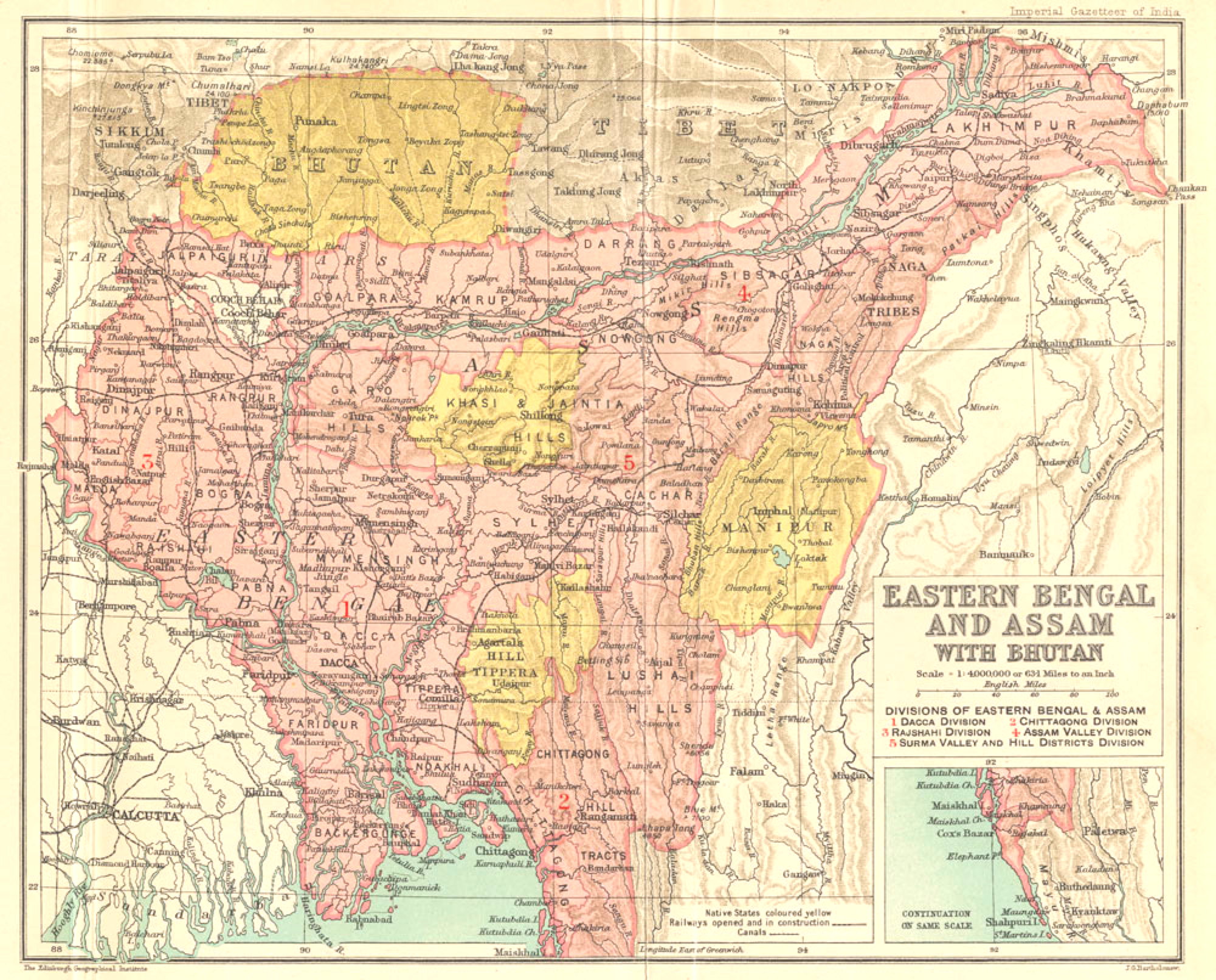
The British design to merge Assam with East Bengal had hurt the ethnic pride of local Assamese people. The decision was perceived by them as an indication that the Britishers are adversely treating their homeland as an extension of Bengal. Despite the fact that the middle class Bengali Hindus has made enormous contributions to the development of Assam’s oil wealth, industry and administration, the authority and power exercised by them over the ethnic Assamese and treating them with arrogance and contempt had ensued grave discontentment and a fear of cultural subordination. Moreover, the continuing large-scale influx of lower class Bengali Muslims was perceived as a demographic conquest by Bengalis to overpower local Assamese – those who were either Hindus or animists. As a result, a deep ‘anti-Bengali’ syndrome developed in the psyche of the ethnic Assamese mass. Hostility, mistrust and socio-cultural conflicts aggravated between the two major linguistic groups and have set the fertile ground for a full scale future confrontation.
Muslim immigration and the linguistic conflict
During the British rule, a big mass of Muslims had emigrated from undivided Bengal to Assam. Local Assamese people were living mostly in Upper Assam and cultivating one crop per year. They were less interested about working in the tea gardens or increasing their agricultural productivity. Hence, to work in the tea gardens, the British tea planters started to import labourers from central India – mainly from Bihar. British entrepreneurs had also actively encouraged landless Bengali speaking Muslim peasants to migrate from the populous East Bengal into the lowlands of Assam to work and develop the vast virgin lands. These poor peasant labourers were hardworking in nature and ready to work with minimal wages. They toiled hard on the waste lands of Lower Assam and transformed it into fertile agricultural fields. The influx of peasant labourers increased with the 1941 Land Settlement Policy. A British government 1931 census report stated that only in Nagaon district, the number of Bengali settlers has gone up between 1921 and 1931 by two thirds, from 300,000 to 500,000. The report also observed that places like Nagaon, Barpeta, Darrang, Kamrup and North Lakimpur were ‘invaded’ by settlers coming from Mymensingh district of East Bengal. These peasant Bengali immigrants made Assam their home and made a significant contribution to the agricultural economy of the state.
In the critical months leading up to Partition, Assam was again in the verge of getting merged with East Pakistan. The Congress High Command and the Muslim League agreed on the Cabinet mission proposal for regrouping of Assam with the eastern part of Bengal, which was to go away with Pakistan. The move was fiercely opposed by Gopinath Borodoloi, the stalwart Congress leader of Assam with the backing of Mahatma Gandhi. Borodoloi successfully prevented the regrouping plan and saved Assam from becoming a part of Pakistan. Combined with the present day territories of Arunachal Pradesh, Nagaland, Mizoram and Meghalaya, Assam sans the pre-dominantly Muslim district of Sylhet, Assam became a state of the Union of India. A July 29, 1947 editorial in Assam Tribune, noted that “…the Assamese people seem to feel relieved of a burden”.
The frustration of this failure to include Assam with East Pakistan left a permanent blotch within a prominent section of orthodox Muslim leadership and reactionary religious groups. This abiding resentment was preserved in their minds as the cherished Islamic design for a Greater Bangladesh which became the major source of future clashes.
Population influx of Bengali refugees, both Hindu and Muslims continued from East Bengal (now East Pakistan) in the post Partition period. It used to accelerate whenever natural calamities, economic or political instability affected East Pakistan. During this time, the ongoing linguistic conflict between the Bengalis and Assamese acquired momentum and turned into a fierce agitation with one side demanding official language status for Assamese and the other side defending the existing status of Bengali. The conflict had a definite political undertone and in 1960-61 burst into violent language riots causing several deaths from both sides. In 1961, Assamese language received the official language status by a legislation passed by the Government of Assam known as the ‘Official Language Act’. However, under pressure from the predominantly Bengali speaking districts of Cachar, Hailakandi and Karimganj in the Barak Valley of southern Assam, the official status of Bengali language was retained there.
After the Indo-China war in 1962, Arunachal Pradesh was separated out from Assam. The state was further Balkanized with the formation of Meghalaya, Manipur and Nagaland in the years of 1960-70s.
Formation of Bangladesh
With the active help and intervention of the Indian government and army, Bangladesh (former East Pakistan) was liberated from the grip of Pakistan and was established as a sovereign secular republic in 1971. It became a highly emotional event for the millions of Bengalis of India, who during the catastrophic Partition days were forcefully uprooted from their homeland in East Bengal and immigrate to India. The utterly traumatic events of Partition had left a profound effect on their lives. In his sensitive films, Ritwik Kumar Ghatak has brilliantly displayed this emotion, longing and trauma of the refugee Bengali Hindu families. Bengali Hindu refugees and immigrants who came to India before or during or after Partition has always related themselves with East Bengal and never with East Pakistan.
But liberation of Bangladesh also sharply increased a fresh influx of immigrants – thousands of Bangladesh nationals started pouring into the bordering states of Assam, Tripura, Meghalaya and West Bengal. The primary reason of this exodus was economic. Bangladesh was a highly populated country where 60 per cent of the population lived below the poverty line. Devastating natural calamities regularly displace millions. Land alienation, poverty, unemployment and lack of adequate social infrastructure prompted the poor Bangladeshi nationals to immigrate into India for a better livelihood. Between 1970 and 1974, the population of East Pakistan (Bangladesh after 1971) amazingly came down from 7.50 crores to 7.14 crores. Though, calculating by the annual population growth rate of 3.10 per cent, in 1974 it should actually increase to 7.70 crores. It is widely believed that the shortfall of 5.60 million has actually immigrated in India.
Twenty-four years have passed from 1947 to 1971 but the nostalgia and longing for desher bari (homeland) was still alive in the refugee hearts. Bangladesh’s liberation generated a wider hope for reinstating their broken linkage and therefore created an ecstatic feeling among them. Though chauvinist-reactionary groups were present in both the sides to spoil the jubilation, the enormity of the event temporarily demoralized and disbanded them. A general mood of elation and friendship was prevailing among the two countries. Triumphant after the victory over Pakistan and temporarily blinded by its own war success, the Indian government at that point failed to contemplate the consequence of this massive influx from Bangladesh.
However this friendship and goodwill gradually evaporated after the legendary leader and founder of Bangladesh Sheikh Mujibur Rahman was assassinated in 1975. Bangladesh eventually discarded secularism in 1988 and declared Islam as the state religion.
The rise of AASU
In the post-Bangladesh era, the Assamese-non Assamese conflict turned in a statewide turmoil with the rise of the All Assam Students’ Union (AASU). AASU came to prominence in 1979 with their ‘peaceful’ agitation (popularly called as the ‘Assam Agitation’) to uncover all illegal immigrants in Assam, deletion of their names from the electoral rolls and their deportation. Calling their movement ‘the 18th war of independence’, an allusion to the 17 wars fought by Assam’s legendary King Lachit Borphukan, AASU claimed that “infiltration and illegal migration is a potential threat to the integrity and sovereignty of the country as well as a demographic danger to the indigenous communities of Assam”. The movement was actually triggered by the discovery of a sudden rise in registered voters on electoral rolls. In the 1970s, the number of registered voters in Assam jumped from 6.20 million to almost 9 million – the increase was mostly accounted for migrants from Bangladesh. Accusing the Congress party for protecting the migrants as a ‘captive vote bank’, AASU constituted a broader platform called All Assam Gana Sangram Parishad (AAGSP) with representatives of various organizations to augment the agitation against ‘illegal immigrants’.
Taking advantage of the deep rooted sentiments and discontentment of Assamese people against the settlers, AASU and AAGSP successfully transmuted it into a widespread popular movement with the clamoured call of ‘Bideshi Khedao’ (kick the foreigners out). Various social-political groups, personalities and intelligentsia played clandestine or active role in this six year long reactionary agitation. The mood of the agitation was well accounted by journalist Chaitanya Kalbagh: “Aside from the anti-foreigner sentiment, the movement has developed other dangerous strains – anti-Bengali, anti-Left, anti-Muslim, anti-non Assamese, and slowly but discernibly, even anti-Indian.” (India Today, 1-15 May, 1980)
The Nellie massacre
AASU had strongly opposed the 1980 Parliament elections and later the 1983 State Assembly election on the ground that the polls be adjourned till electoral rolls were cleansed of illegal immigrants. Amid the ongoing agitation, the Congress government went ahead for the State Assembly polls in February 1983. During the polls the state witnessed large-scale arson, communal disturbances, group clashes and killings. The violence had no particular pattern – ethnic clashes between Assamese tribal and non-tribal; communal clashes between local Hindus and immigrant Muslims and linguistic clashes between Assamese and Bengalis occurred all over the state.
On February 18, a day after the polling has concluded, the village of Nellie in Nagaon district, 34 miles north-east of Guwahati was virtually turned into a killing field by a horrific and brutal massacre. According to official figures, on a single day, 2191 innocent and very poor Bengali Muslims, mostly women and children, were butchered in broad daylight by Assamese Hindus and Lalung tribals. Twenty-five years have passed but the Nellie massacre still remains an extremely mysterious case where no one claimed responsibility for the massacre, no judicial probe or independent enquiry was ever demanded by the Congress or the AASU, a Commission of Inquiry was instituted but the 600-page report was never made public and not a single person was convicted. The Congress and subsequent AGP government suppressed all information and deliberately tried to rub off the gruesome and shameful episode from the memory of Assam. (For an eyewitness account of the Nellie massacre see: Bedabrata Lahkar, Recounting a nightmare)
Enactment of IMDT Act
Despite the existence of the Foreigner’s Act 1946 which gave the Indian Government certain powers to execute in respect of the entry, presence and departure of foreigners inside the Indian Territory, the Indian parliament in 1983 enacted the Illegal Migrant Determination by Tribunal Act (IMDT). Unlike the existing Foreigner’s Act which was applicable to the whole of India, IMDT Act was solely applicable to the state of Assam and projected as an instrument to detect illegal immigrants from Bangladesh and expel them. There were fundamental differences between the two acts. According to the Foreigners Act, a suspected illegal immigrant has to establish his/her nationality on their own whereas under the IMDT Act, the responsibility of proving the citizenship of a suspected illegal immigrant lay on the complainant. The act was a focused political move initiated by Delhi – to spoil the growing influence of AASU and to protect genuine Indian citizens affected by the Assam Agitation, both religious and linguistic, from the undue harassment of been termed as illegal. Interestingly, the IMDT Act was passed by a Parliament, which had no members from Assam due to a boycott of elections on this issue.
The IMDT Act was challenged in courts by MP Sarbanand Sonowal of AGP. In 2005, a three-judge Bench of the Supreme Court struck it down as unconstitutional and directed to set up fresh tribunals under the Foreigners Act, 1946 and Foreigners (Tribunal Order) 1964.
The Assam Accord
The violent ‘direct action’ agitation of AASU continued for six consecutive years till the signing of the Assam Accord in August 15, 1985. The Assam Accord was a tripartite agreement between AASU, the government of Assam and the government of India. After much debate and negotiations, AASU retracted from its earlier demand of deporting all migrants who came after 1951 as ‘illegal’ and agreed on to recognize March 25, 1971 (the day civil war in East Pakistan began) as the cut-off date to determine ‘foreign infiltrators’ in Assam.
Signing of the Assam Accord was celebrated as a political victory of AASU. The state Assembly was dissolved and Hiteswar Saikia headed Congress government which came to power after the infamous February elections was dismissed. Within three months, AASU was transformed into a regional political party called Asom Gana Parishad (AGP) on October 14, 1985. Fresh elections in December 1985 brought AGP in power. After coming to power the AGP government adapted half-hearted and shortsighted measures to deal with the immigration problem. All cases connected with the Nellie massacre were dropped.
Though the IMDT Act had depraved political intentions and has basic flaws from its inception, it is extremely interesting to recall that AASU or AGP did not raise any uproar about the shortcomings on identification, detection and deportation of illegal migrants in the act, which was enacted just two years before the Assam Accord. It was only after losing power in the 1991 assembly elections to Congress; AGP started a hue and cry about the defects of IMDT Act and demanded for its repeal.
The rise of armed insurgency
The volatile situation in Assam for decades had paved the way for various terrorist-insurgent groups of different scale and size to mushroom and commit scores of violent and mindless incidents like murders, triggering blasts, abductions for ransom, extortions and attacking of economic targets. The South Asia Terrorism Portal website has listed 36 such terrorist-insurgent groups in Assam. Prominent among them are the United Liberation Front of Asom (ULFA), National Democratic Front of Bodoland (NDFB), United Liberation Front of Barak Valley (ULFBV), Dima Halim Daogah (DHD), Kamtapur Liberation Organization (KLO), Muslim United Liberation Tigers of Assam (MULTA), Muslim United Liberation Front of Assam (MULFA), United People’s Democratic Solidarity (UPDS), Karbi Longri North Cachar Hills Liberation Front (KLNLF), Black Widow, Bodo Liberation Tigers (BLT) and Barak Valley Youth Liberation Front (BVYLF). Many of the smaller groups are actually the offshoots of major groups. The objective of most of the groups is secession from the Indian State. However, except ULFA, most of the secessionist insurgent outfits that had appeared during the turbulent days of 1979-1983 did not survive after the Assam Accord.
By going through the list, one will be startled to find that with the exception of ULFA most of the groups have a specific ethnic-religious representation. It is seemingly obvious that the root cause of armed insurgency in Assam is the widespread and deep rooted ethnic cultural conflict prevailing in the region that is fueled by the failure of subsequent governments and mainstream political parties to understand the local people’s mind. The rise of ethnicity based insurgency and the separatist demand for sovereignty were the direct result of a general feeling of alienation, dispossession and fury among the ethnic community which considered that armed insurgency is the only way to make their voices heard. The presence of about 20 large and small ethnic groups with differing belief systems and way of life and the unique geographical location has facilitated the rapid development of terrorist-insurgent activities in Assam.
There are also roughly 14 Islamist terrorist outfits operating in Assam, those who attempts to mobilize the Muslim youths in Assam to fight for the ‘cause of Muslims’. Pakistan and Bangladesh based foreign terrorist groups like Harkat-Ul-Mujaheedin, Harkat-Ul-Jihad, Jamat-Ul-Mujaheedin and Harkat-ul-Jihad-al Islami (HuJI) are also reportedly having active presence in Assam. Another militant outfit named Islamic United Revolution Protect of India (IURPI) has been formed recently covering the Muslim dominated districts of Assam.
The menace called ULFA
United Liberation Front of Asom (ULFA) is a well organized, highly influential, widely connected, enormously funded terrorist group active in Assam. During the height of anti-foreigner agitation, a hard line section parted from AASU to form ULFA. Born on the lawns of the historic Rang Ghar of Sibsagar on 7th April 1979, ULFA leaders Rajiv Rajkonwar alias Arabinda Rajkhowa (chairman), Samiran Gogoi alias Pradip Gogoi (vice-chairman), Paresh Barua (chief of staff) and Golap Baruah alias Anup Chetia (general secretary) declared their aim of “liberating Assam from the illegal occupation of India” and to establish a ‘sovereign socialist Assam’. By describing itself as a ‘revolutionary political organization’, ULFA gave a militant manifestation to the anti-foreigner movement but initially remained concealed by acting along with AASU.
There is a fundamental difference between the ideologies of AASU and ULFA. AASU’s agitation was pointed against ‘illegal immigrants’ whereas ULFA’s struggle is solely against the Indian State: “to overthrow Indian colonial occupation from Assam”. The ULFA does not consider itself a separatist or secessionist organization, as it claims that Assam was never a part of India. Arbinda Rajkhowa, chairman of ULFA once said that, “India has been occupying Assam illegally like Kashmir, which was never an integral part of India”. ULFA claims that among the various problems that people of Assam are confronting, the problem of national identity is the basic, and therefore represents “not only the Assamese nation but also the entire independent minded struggling peoples, irrespective of different race-tribe-caste-religion and nationality of Assam”. It must be mentioned here that ULFA has always refused to admit their involved in any ethnic or communal violence but always admitted their role if the attack was against the Indian security forces or any target symbolic to the Indian State like the state-owned oil pipelines. It is principally a secular outfit and fiercely against Hindu nationalist groups and the BJP, calling it ‘out and out a Hindu fundamentalist party’. After the Babri Masjid demolition in 1992, ULFA was credited for stopping Hindu-Muslim riots ‘by displaying arms openly’ in the Hojai region of Nagaon district.
ULFA’s initial cadre recruits were from AASU. But later they started recruiting cadres directly, particularly from the rural belts. Even after the outfit was banned and Indian Army operations resumed in September 2006, the continuing presence of ULFA suggests that the organization has somehow maintained their rural influences and the pattern of cadre recruits. The outfit has a mixed cadre base comprising Assamese and ethnic tribals – even Bengali peasants. ULFA is believed to have a trained cadre-strength of around 5,000 and possesses a huge cache of weapons for its insurgent activities.
Around the mid-80s ULFA started showing its true face with low-intensity military conflicts, political homicides and economic subversion and was soon recognized as a potent terror organization. By dividing insurgency activities between its political and military wing ULFA started raising huge funds through extortions and threatening rich businessmen and tea estate owners and also looted banks. The outfit’s major operational area was the Dibrugarh-Tinsukia sector, the wealthiest tea-growing and oil producing region of Assam. Almost every tea plantation paid an annual ransom to them. In 1986, ULFA leaders established contacts with National Socialist Council of Nagaland (NSCN) and the Kachin Independence Army (KIA) of Myanmar to procure arms and arrange for training of its cadres. The Kachins taught them the essentials of terrorist-insurgent tactics. One of its daring attacks was in May 1990 when ULFA cadres killed Surendra Paul, one of the leading tea planters in Assam and brother of famous UK-based businessman Lord Swaraj Paul. The incident caused many tea estate managers to flee Assam. Soon the government sprung into action. The entire state of Assam was declared a ‘disturbed area’ and ULFA was banned on November 1990 as a terrorist group. Since 1990, the Indian security forces are engaged in Assam to stall ULFA activities.
Controlling the ULFA menace became a dilemma for the AGP government as the leaders of AASU-AGP and ULFA were the same lot of people, born from the same arena. “The cynical characterization of the same set of people as ASSU in the morning, Government (AGP) at midday and ULFA at night cannot be just laughed away” (M. Kar, Muslims in Assam Politics - 1946-1991, page 421; quoted in R. Upadhyay, ULFA – A Deviated Movement? ) Taking this advantage, ULFA almost ran a parallel government in Assam, conducting trials of people and black mailing them for extorting money. The AGP government had also encouraged ULFA activities to some extent to keep alive their confrontational politics and pressure over the Central Government. “The reasoning behind the unwillingness on the part of the AGP regime to confront the ULFA lies in its eagerness to keep the terrorists actively alive to retain its anti-centre leverage” (Ibid. page 425). On the other hand, ULFA’s popularity and influence gained a spectacular rise from the rising disillusionment among the Assamese people against the AGP regime.
Contrary to its original ideological position of a revolutionary political organization and dumping its ‘social-reform’ activities, the ULFA leadership has done a complete volte-face when they transformed the outfit into a purely terrorist outfit. Later on, ULFA established contacts with Inter Services Intelligence (ISI) of Pakistan, Defense Forces Intelligence (DFI) of Bangladesh, the Afghan Mujahedeen and other terrorist-insurgent groups of North-East and committed a series of atrocious crimes to create terror in the State. Since 1989, ULFA Chief of Staff Paresh Barua, however, has denied the alleged link of ULFA with ISI as a ‘heinous conspiracy of New Delhi’.
ULFA had put up a number of camps in Bangladesh and also owned several ‘income generating projects’ like media consultancy firms, soft drink manufacturing units, transport companies, schools, three hotels, a private clinic, two motor driving schools, a tannery, a chain of departmental stores, garment factories, travel agencies, shrimp trawlers and investment companies there. ULFA also runs profitable narcotics business in Myanmar and Thailand. Paresh Barua was allegedly involved in smuggling heroin from Myanmar into Assam. ULFA leaders and cadres had reportedly received specialized training on counter intelligence, disinformation, use of sophisticated weapons and explosives from ISI. Two Muslim terror outfits of Assam – the MULTA and the MULFA are their regular arms suppliers through Bangladesh. Routed through Nepal, it has also developed channels for the transfer of funds and arms from Thailand, Myanmar and Cambodia.
ULFA continues to be active but has lost its credibility to a great extent due to its involvement in the mindless violence, killing of ordinary people and lumpenization of its cadres. On January 2007, suspected ULFA extremists killed at least 62 Hindi-speaking Bihari daily labourers, workers of brick kiln, petty-traders and roadside vendors in Dibrugarh, Tinsukia and Sibsagar districts of Upper Assam. Its popular support has reduced but not fully erased. There is still an underlying sympathy about ULFA in the greater Assamese society, especially among the underprivileged, middle-class and intelligentsia. “A section of the intelligentsia, however, uses the insurgent influence as a shortcut to secure personal objectives and fame. It is not a rare exception in Assam to find a respected intellectual advocating the insurgent cause, of course from a safe distance and carefully balancing constitutional restrictions and revolutionary babble. Many among the more sober intellectuals in Assam prefer to maintain a deliberate silence on the issue.” (Sunil Nath, Assam: The Secessionist Insurgency and the Freedom of Minds) This sympathy among its home-population is ULFA’s key strength.
Journalist and North-East expert Sanjoy Hazarika has summed up the present status of ULFA and other terrorist-insurgent groups of North-East:
“…it should be clarified that the conflicts in the Northeast, in terms of armed revolts, ethnic struggles or fights against the Indian State, no longer draw on the romanticism and idealism that sustained fighting groups and communities for decades. Dreams have degenerated into nightmares; the fighters have turned on each other and on the people in whose name they claim to speak. The entire network of cadres, recruits, informers and political leaders is based on extortion and extraction: extortion from business houses and petty traders, from professionals, contractors and politicians. Few are spared. The extraction process even involves government officials…”
The HuJI and RSS-BJP factor
Harkat-ul-Jihad-al Islami or HuJI is a fanatic terrorist outfit formed at Pakistan in 1984. It initially operated in Afghanistan, then at Jammu-Kashmir and later was extended to Bangladesh in 1992. Banned in Bangladesh since October 2005, the objective of HuJI is apparent from their one-time slogan: Amra Sobai Hobo Taliban, Bangla Hobe Afghanistan (We will all become Taliban; we will turn Bangladesh into Afghanistan). It is a deadly terror outfit operating from the coastal area of Chittagong south through Cox’s Bazaar to the Myanmar border. In recent years, this Bangladesh chapter of HuJI has been found to be responsible for a number of terrorist strikes in India with the active assistance from ISI.
Since 1998, unconfirmed reports were emerging about HuJI-ULFA links. The connection was proved in 2003 from the confessions of some arrested jihadi militants and reconfirmed recently when members of HuJI were spotted in the Silchar district of Assam along with a few ULFA members. HuJI is reported to have assured co-operation and logistical support to ULFA and help them to find shelters in Bangladesh. Reports has also indicated that HuJI is giving a three months military training to youths and helping them to infiltrate into Indian locations like West Bengal, Assam and other North-East states.
The RSS (Rashtriya Swayamsevak Sangh) - BJP (Bharatiya Janata Party) combine has built up a wide network in the districts of Udalguri and Darrang in recent years. This combine has influenced a section of the Bodos along with a small section of Assamese, Bengalis and Nepalese to mobilize against the Muslims in many places of the state. In the name of detection of the suspected ‘Bangladeshis’, numerous harassments and atrocities are imposed on those Muslims who had actually settled in Assam long back and became a part of the broad Assamese society. The recent clashes and rampant violence between Bodos and Muslims that has swept across many areas in Udalguri and Darrang districts from October 3, 2008 is the result of this evil design of RSS-BJP. “...the rifts and conflicts engendered by the communal violence among the Bodo and Muslim communities will be sought to be utilized by the divisive, communal and fundamentalist forces to their advantage and thus further endangering the peace and unity among the people.” (Uddhab Barman, Behind the Recent Communal Violence in Assam, People’s Democracy, 19 October 2008) Accordingly, after the October 30 serial blasts, BJP leader L.K. Advani took no time to blame illegal Bangladeshis (read Muslims) as the main reason for breeding terrorism in Assam.
Consistent violent campaign against Muslims with the growth of the RSS-BJP combine in Assam has created enough ground for the growth of communal and fundamentalist forces among the Muslim community (Muslims constitute nearly 30 per cent of Assam’s population). Taking advantage of this chaotic situation, HuJI and other fundamentalist Muslim outfits are gradually penetrating deep into a section of the Muslim inhabitants and brain-washing them towards Islamic fanaticism. ULFA leaders, being pushed to the wall by the mounting emphatic operations of Indian security forces have been coerced to enslave them in the hands of the ISI for survival. Today, ISI has sheltered all the top leaders of ULFA in Bangladesh. The outfit has abdicated its core ideology and acting now as their local agent in Assam and the North-East.
Conclusion
You are walking along the street one day,
chewing cinnamon gum,
and the world is full of cinnamon
when there’s a fireball--
and a blast of gushing air and noise
like the Earth is cracking
and time has exploded. ...
Then ... silence. ...
You think you’re okay, but you look down and your forearm
lies in the street like a dead snake and you collapse.
You are twenty two and you have/had a good job--
you were earnestly trying to help.
But now you think there was no point to your life,
and you remember your mother and father
whose voices are in the sirens.
– Gary Corseri, A Bombing in Assam
Ten days after the recent blasts, the Indian Home Ministry claimed that they have found “…enough evidence that the banned ULFA had carried out the October 30 serial blasts with the help of dominant Bodo militant group NDFB.” NDFB is currently under ceasefire with the security forces and is engaged in peace negotiations with the government. The government sources has expressed their worry about a nexus between local outfits with outsiders in the blasts the fact that ‘northeast militants has started using a deadly mixture of RDX, ammonium nitrate and plasticised explosives’ and neither ULFA nor NDFB has the expertise to carry out such dead explosions. Bangladesh-based HuJI has provided the expertise to ULFA and NDFB. (Indian Express, 11 Nov 2008)
For several decades, Assam is passing through too much of tears and blood. This stunningly beautiful state and its people are struggling hard to come out from the curse of their own history.
Secessionism, insurgency and terrorism are like the mythical Phoenix bird – self destructive but able to resurrect from its own ashes. Assamese people did clutch them all – like a drowning person clutches a piece of straw.
Dealing the problem from a fascistic perspective, the widely spread jingoistic approach of the RSS-BJP combine will be a catastrophe. The problem cannot be dealt as well with a feeble, compromising and brush under the carpet approach – as implemented by the Congress party. The people of Assam are bearing the brunt of this breed of politics for long. It also cannot be dealt with reactionary parochialism – like the provincial politics of ASSU-AGP. The people of Assam have long been disillusioned by them. The distressing reality for Assamese people is, that they do not have any other alternative to choose.
The Indian State should first and foremost study the people and learn how to create a condition that will itself refuse to extend any popular sympathy or support towards the secessionists, insurgents and terrorists. It has to realize that a convincing democratic mechanism that compassionately tries to comprehend the genuine grievances of its own people and works effectively for a tangible solution will definitely win back their support. The same support which is partly enjoyed today by the secessionists, insurgents and terrorists. An unbiased approach towards the political problem of secessionism and a firm determination to strike against terrorism is the correct approach to deal the Assam crisis.
Friday, October 31, 2008
The BJP and the ‘Hindu Terrorist’
 It is not surprising to see the Bharatiya Janata Party (BJP) in dispute with the term ‘Hindu Terrorist’. The term has been introduced by the Indian media after the recent arrest of five activists of the Hindu Jagaran Manch (HJM), an Indore-based Hindu extremist group and Sadhvi Pragya Singh Thakur, a former national executive member of BJP’s students wing Akhil Bharatiya Vidyarthi Parishad (ABVP). The arrested persons were allegedly part of the September 29 bomb blasts in the Muslim localities of Malegaon in Maharashtra and Modasa in Gujarat. In an obvious attempt to mislead the investigation, the perpetrators in Malegaon had placed bombs in a motorcycle and parked it below the now-defunct first floor office of Students Islamic Movement of India (SIMI) while the motorcycle used in Modasa had Islamic stickers on its seat. The terror attack is still under investigation by the Maharashtra Anti-Terrorism Squad (ATS).
 The arrest of the Sadhvi has particularly embarrassed the parent body Rashtriya Swayamsevak Sangh (RSS) and its political wing BJP. Photos and video clips of the Sadhvi, seen with prominent BJP leaders including party president Rajnath Singh are widely circulated in the media. As a damage control measure, the RSS and BJP have started to blame the arrests as an ‘ultra-secularists’ ploy, voraciously defending the ‘malicious’ attempt to ‘assail the majority community’ with the terrorist tag. At the same time they have neatly washed off there hands by denying any link with the Sadhvi. However, expelled BJP heavyweight leader Uma Bharati has sprung to the Sadhvi’s defense saying she was shocked to see the BJP disown the Sadhvi and quipped: “they had no problems in using her when they wanted to”.
*****
One of the most virulent forms of terrorism in our times seeks the cover of Islam. It calls its murderous campaign ‘jihad’, thereby trying to justify itself in the eyes of pious God-fearing Muslims. – L. K. Advani, My Country, My Life
The biggest threat the country is facing today is ‘jihadi terrorism’ – Rajnath Singh
It is our adversaries, and not us, who are misrepresenting that the fight against terrorism is fight against Islam and the Muslim community. – L. K. Advani
I want to assure the people that if they vote the BJP led NDA to power at the centre then we will bring a strong law against terrorism to crush the morale of the terrorists who seek to operate in India. – Rajnath Singh
*****
Relating to the choice of words, the BJP has started blaming the media for ‘double standard’. However, along with ‘Hindu Terrorist’ the media is also frequently using the term ‘Islamic Terrorist’ and ‘Islamic Terrorism’. The internet space is flooded with this term, prominently in the pro-Hindutva websites and blogs, even in the ‘reader’s forum’ pages of RSS mouthpiece Organiser. The conscience of the BJP leaders never felt the obligation to openly register a protest against it and was more than happy to relish this media service as it was creating a negative public opinion concerning the Muslim community. How come the media is blamed now for ‘double standard’? Is it not in fact the BJP’s ‘double standard’ tactic to remain mute about ‘Islamic Terrorist’ and proactively oppose the term ‘Hindu Terrorist’?
Why are the BJP so upset by the development?
The first reason is purely ideological. As per their core RSS teaching, the BJP believes that the word ‘Hindu’ is synonymous with the nation. Therefore, the use of the term ‘Hindu Terrorist’ is a direct ‘insult and abuse’ to the Indian Nation and therefore anti-national. This view is best reflected when the BJP spokespersons say that no Hindu can ever be an extremist.
Secondly, the BJP predicts that the development might hinder their meticulously crafted grassroot propaganda (with the muscle of RSS machinery) that all Muslims are potential terrorists – the party blueprint to incite Hindu sentiments on the eve of the next Lok Sabha polls. They are worried that their political opponents now have got a potent weapon against them. Also, in the minds of a vast majority of India’s plural society, the development has reconfirmed their assertion that one of the major cause of terror attacks which has sprung up in different parts of the country is the reaction to a malicious brand of politics practiced in India in the name of ‘nationalism’– the politics of hate.
BJP leaders are therefore proactive to voice their pristine view on terrorism and terrorists. According to them, irrespective of his/her religion or cast, a terrorist is simply a terrorist. Then why link terror with a particular religion? As always, the BJP is emulating their characteristic rhetoric of a calculated ambiguity. They are intensely opposing the ‘Hindu’ tag but not explicitly opposing the words ‘Muslim’ or ‘Islamic’ tagged with terrorism. Not a single statement issued by the party has specifically said that they are also against the term ‘Muslim Terrorist’.
BJP’s five point defense strategy is simple:
1. Not to use the term ‘Muslim Terrorism’ directly from public platforms. Instead, use ‘Jihadi Terrorism’ or ‘Islamic Jihadi’.
2. To proclaim with determination that no Hindu can ever be an extremist.
3. To intensely counter the term ‘Hindu Terrorist’ from all forums with the pretext that BJP have always believed that terror has no religion.
4. To be clamorous about homegrown jihadi cells; ‘terrorist factories’ of Azamgarh and SIMI. Link all terror attacks with Pakistan (which the Parivar considers to be a terrorist state) and Bangladesh, and constantly harp on about Bangladeshi infiltration. Talk about bringing a robust law (even stronger than POTA) against terrorism to crush the morale of the terrorists if BJP led NDA is voted back in power.
5. Diminish all secular voices by calling them ‘pseudo secular’ or ‘ultra-secular’. In response to all political adversaries, constantly go on saying that they are all ‘appeasing’ the minority community just to gain the minority votes.
The BJP leadership has strategized that persisting on these five points will facilitate a duel purpose. In one way it will help the party to craft a pan-Indian image, comfortable to various political partners and the section of the Hindu public who are not yet prepared to sanction a militant Hindu programme. Simultaneously it will also keep its cadres assured that the core Hindutva schema – building the Hindu Rashtra, is preserved as a hidden agenda which will be exposed in proper time.
This moderation to channelize its core Hindu nationalist and anti-Muslim position through a more agreeable ‘patriotic’ and ‘anti-foreign enemy’ (Pakistan, Bangladesh and jihadi terrorism) approach is largely due to the BJP’s coalition building compulsion. In his detailed study 'The BJP at the Centre', the French scholar Christophe Jaffrelot has noted that, “The moderation of BJP does not follow a linear trend but represents merely a phase reflecting its capacity to alternate moderation and extremism”. (Emphasis added) Party strategists think it to be a more pragmatic approach by which the party will build an acceptable mask in front of the public at the eve of the 2009 Lok Sabha elections. As famously disclosed by the former BJP theoretician K.N. Govindacharya that Atal Bihari Vajpayee was presented as a mukota (mask), today, the whole party is in the finishing stage of a process to conceal behind a mask covering its Hindutva face.
One thing is for sure – this strategy is not to persuade the Muslims of India. It is actually intended for a different audience – the millions of (pseudo!) secular minded Hindus of India who still condemn the hateful ideology and agenda of the BJP. To bring them into their fold through its coalition allies, the BJP with the approval of RSS had already dropped contentious issues like Ram temple construction, abolition of Article 370 and imposition of a uniform civil code from its ‘national agenda’. This is why the 1999 election manifesto of BJP led National Democratic Alliance (NDA) promised a ‘moratorium on contentious issues’. While justifying this new discourse and change of their political line, the top leaders of BJP had brought into play big words like ‘commitment to good governance’, ‘responsible party, alive to the interests of all section or society’ and ‘no place for an ideological party in India today’. A steady supply of skillfully practiced ambiguous words and more words has become a definite characteristic of the party.
The BJP leaders and spokespersons have mastered the art of twisting political jargon according to the demand of the situation and blending them in an ambiguous manner into their rhetoric. The one word ‘pseudo’ is a most endearing word in the Sangh lexicon and the users have almost turned the word into a cliché. It is been freely used against any person who disagrees to the ideology or opinion. The hydra-headed Parivar affiliates are even using the word within the brotherhood to tweak each other. The great Atal Bihari Vajpayee was also not spared and called a ‘pseudo Hindu’ by Acharya Giriraj Kishor, the senior vice-president of the Vishva Hindu Parishad (VHP) the religious and proselytization wing of RSS, when the Vajpayee led NDA government did not give priority to facilitate building the Ram temple in Ayodhya. BJP’s cerebral makeup has been perfectly exposed by the lawyer and constitutional expert A.G. Noorani: “Deceit and deception are integral to the RSS-BJP strategy”.
The leadership of BJP considers the Indian public as fools.
This blogger in a previous post has argued that terrorism primarily emerges from socio-economic reasons that create a feeling of frustration and grievances within a section of the society. This frustration and grievances lead towards aggression and is modified into a political tactic when the section starts believing that no other means will affect the kind of change they desire. Its method and strategy generally follows a similar line of committing acts of violence but with variable causes and targets that depends on whose point of view is being represented.
Terrorism is a deeply complex subject and cannot be connected with religion alone. The BJP is deceitful while propagating the same thing today. It remains as a fact that equating Muslims with terrorism is totally a RSS-BJP making – an integral part of their wider Hindutva agenda.
Saturday, October 18, 2008
Indian Muslims and terrorism: a short discourse
 The majority section of Indian society, the ‘concerned’ Hindu citizens are demanding that the Indian Muslims must immediately start to speak out and take counteractive steps against the terrorist attacks instigated by fundamentalist and anti-national Muslim groups. They are outright critical about the attitude of common Muslims and Muslim organizations of the country for not doing enough to voice their protest and instead preferring to remain mere spectators of the spiteful events. They have raised a ‘valid’ question: is this not the ideal time for Indian Muslims to prove their loyalty to the Indian state? If they are honestly against these felonious acts of homegrown terrorists, if they genuinely feel that terrorists are demeaning the entire Muslim population and in the name of Islam destabilizing the Indian society, then why are they not coming out in flocks to express their concern? A lot of voices have been built up in favor of the above view. Therefore, it is worth probing the elements of this complicated topic in detail.
 During the Partition of India in 1947, a substantial number of Muslim families decided to live in secular India instead of migrating to Islamic Pakistan. It was a difficult but cognizant decision, based largely on the official stand of the new Indian Government which wanted to be recognized as a secular state. The important part played by a significant section of their Hindu neighbors and friends must also be mentioned, those Hindus who did provide the required confidence and solace to their Muslim brothers and sisters to reside beside them. At that time it was not an easy decision for the compassionate Hindus either in front of large-scale killing and violence. Communal elements were present in both communities, feeding each other on an agenda of hatred and intolerance. The Partition dusts settled down in time but left a deep scar on the face of the newborn nation. Today’s younger generation of Muslims were born and brought up in a secular-democratic India and has little or no mental connection with the Partition period’s assault of communal violence on their ancestors. They live and share the democratic milieu of this country equally with their Hindu counterparts.
Is it then beyond question that by having an equal stake in the system with their Hindu counterparts, the present day Indian Muslims should have no basis to be apathetic to the country’s democratic values? To find an answer to that we should look into the actual conditions wherein majority of the Indian Muslims live.
As per 2001 census estimates, India has roughly 150 million Muslims, constituting 13.43 per cent of the Indian population. They represent the second largest Muslim population in the world, behind Indonesia (190 million) and just ahead of Pakistan (about 140 million). The Indian Muslim community is larger than the entire population of Arab Muslims (about 140 million). Despite such a huge presence, Indian Muslims by and large are living in appalling socio-economic conditions. All post-independence commissions set up by the Indian government in an effort to find out the social, economic and educational status of Muslims – from the 1983 Dr Gopal Singh Commission to the 2006 Rajinder Sachar Commission have shown a dismaying portrayal of the community. The latest report by Rajinder Sachar Commission has established the following disturbing statistics:
1. 48 per cent of Muslims older than 46 years age can't read or write. In the age group of 6 to 14 years, 25 per cent of Muslim children are either dropouts or have never attended school. As far as enrolment ratio in schools are concerned, the share of Muslim children is lower compared to the schedule caste and schedule tribes.
2. Primary, secondary and higher secondary – at every level the dropout ratio is the highest among Muslims. Only 3 per cent of Muslim children attend the madrasa. Out of the total Muslim population of around 14 crore, only about 4 crore Muslims have received some education — 192 lakh are educated till primary level, 105 lakh till secondary, 73 lakh till higher secondary and 24 lakh till graduate level. A large section among the Muslims is Urdu speaking, but the infrastructure to teach Urdu is miserable.
3. 52 per cent of Muslim men and 91 per cent Muslim women are unemployed. Representation of Muslims in government jobs is far below their proportion in total population. They hold only 7.2 per cent of government jobs and only 3.2 per cent of the jobs in the country's security agencies (namely, CRPF, CISF, BSF, SSB etc). In some states like Delhi, Tamilnadu, Bengal, Maharashtra and Uttar Pradesh, the percentage is even lower.
4. In towns that range in population between 50 thousand and 2 lakhs, Muslim per capita expenditure is less than that of scheduled castes and scheduled tribes.
5. Although they make up only 13.43 per cent of the total population, 40 per cent of the prison populations in India are Muslim.
Except if one utterly believes the Hindutva apologist’s propaganda that the Sachar Commission report is ‘full of prejudices’ and ‘politically motivated’, there should be little doubt from the above data, that the condition of common Muslims in India is not at all promising and needs a drastic change. Muslims in India have fallen behind the rest of the population, especially in employment opportunities and education. Large section of this Muslim populace is living under extreme poverty. In urban areas most of them are raised in ghettos near to posh neighborhoods, lacking the basic infrastructural facilities like clean water supply, sewage or sanitation system, banks and schools. In almost every three Muslim dominated villages, one does not have a school. Nearly 40 per cent of the Muslim dominated villages do not have proper roads, drinking water and health facility. A large section of ordinary Muslims are low status or downtrodden. A sizable section among them is former dalits, converted to Islam. Their conversion over the centuries has not helped them to realize any noticeable socio-economic uplift.
The Hindutva apologists obviously have very strong disagreement to this report as it has bluntly shatter their circulated myth about Muslim ‘appeasement’ by the ‘pseudo secular’ political class of this country. On the other hand, the report has also exposed that since independence, the main political parties have mostly ignored elevating the community in socio-economic terms. Time and again these political parties and leaders shed crocodile tears and in the excuse of ‘helping’ Muslims, compromise with the most reactionary elements among them. Time and again it was observed that these leaders and political parties erase out the community from their mind without actually carrying out any enduring benefit to them once their political goals are achieved.
From the education perspective, the situation of Muslims in India is rather depressing. From a very young age, Muslims who attend the madrasas (although only 3 per cent as per the Sachar report) receive orthodox religious teachings and throughout their lives earnestly follow it. The normal teaching trend in the madrasas is to minimize the intellectual and rational sciences and stress on purely religious orthodox disciplines, the dos and don’ts of Shariati laws and so on. The conditions of the dropouts or those who have never attended school (25 per cent as per the Sachar report) are even pathetic. They are the most wretched and deprived in the community, their outlook and values of life develop straight from their downcast and conventional social upbringing. The psyche of a larger section of young Muslims are shaped by these conventional and orthodox lessons of Islam, most of the time interpreted by the ulemas in such a way that learners are bound to incline towards a dogmatic approach in life, always suspicious to modern liberal values. The religious beliefs and practices form a blind faith on religion and thus it becomes easy for conservative minded religious Muslim leadership to draw the community's agenda in strictly religious terms, neglecting the importance of socio-economic empowerment of the community. Modern rationalistic approach towards life is absent in this rigid religious atmosphere. As a result, it becomes obligatory for the inhabitants to learn Urdu, the women to adopt veil, children to receive Islamic orthodox teachings and to grow up with all sorts of conservative values.
The role of Islamic organizations in India is also not beyond criticism. These organizations are less concerned about social and educational reforms but instead spend most of their energy and resources to organize the community in religious lines. By stressing on an identity related threat, they try to segregate the minds of common Muslims from secular lenience to religious fanaticism.
The increasing communal polarization of the Muslims has aggravated after the speedy growth of Hindutva ideology in Indian society following the Babri Masjid demolition on 6 December, 1992. This event and the subsequent communal propaganda set off by the hydra headed Sangh Parivar was responsible for strengthening the anti minority bias in all sections of Indian society and was successful to manage a parliamentary victory in the national elections for its political wing Bharatiya Janata Party (BJP). Upbeat after the electoral victory, the Parivar and its offshoots started to systemically unleash sporadic attacks on the minorities in many parts of the country and forced them to gradually segregate from the mainstream. While under direct or indirect communal attacks, the socially alienated ordinary Muslims cling more towards religion for comfort and support. Communal elements among the Muslim community have also added fuel to the fire. These elements equally contributed the increasing communal polarization and have stirred up a widely shared perception among the community that their identity is being undermined by the systemic propaganda and actions of Hindu communal forces. The degraded conditions of the ordinary Muslims were bit by bit gathering all the right ingredients for extremist Islamic ideology to spread its root among them.
Just when the Gujarat riots happened.
Immediately after the terrible incidence of Godhra train burning on 27 February 2002, Gujarat chief minister Narendra Modi called it “a one-sided collective terrorist attack by one community”. The following day, his speech was broadcasted on Ahmedabad Doordarshan where he remarked, “…we will set an example that nobody, not even in his dreams, thinks of committing a heinous crime like this.” From 28 February onwards, in the pretext of the ‘terrorist’ label, Hindutva communal fanatics with the active support of the state police unleashed an unprecedented collective violence upon the entire Muslims in the state. The pogrom was like a moral compulsion to the perpetrators that their robust action was the right reaction to Godhra train burning and was essential to cleanse the Indian society from the evils of radical Islam – to ‘defend the Hindu religion’. Numerous Muslim houses, shops along with people were gutted; mosques and shrines were damaged or destroyed and in the place makeshift Hindu temples were built. The largescale violence did not spare women and children; wealth and status could not shield the victims. The chief minister, instead of controlling the situation justified the pogrom by saying “it was a spontaneous reaction of the people against the terrible events of Godhra”. According to official estimate, 1044 people were killed in the violence – 790 Muslims and 254 Hindus (including 58 victims of the Godhra train fire). 1,50,000 were left homeless.
Who were beside the victimized Muslims when Gujarat was burning? It was some Muslim voluntary groups and few social activists. On ground, not a single political party dared to confront the killers or has protected the traumatized Muslims. Literary critic and activist Ganesh Devy at that time had bitterly remarked, “There is no political or ideological divide in Gujarat on the Muslim question; even the Congress hates Muslims.” The government looked the other way when its healing touch was required the most. Under brutal attack perpetrated by the religious majority, the hapless Muslims cocooned into grungy relief camps for years and were fixed more ardently to their faith. This is a perfect time for fanatic ideas to creep in. There is always an immense possibility that extremist radical thought could infiltrate and influence the victims and their kith and kin, mostly youths, when they find their whole surroundings including the civil society, government agencies and the hate factories of vernacular media are totally against them only because they belong to a particular religion. A compassionate social attitude and a concerned government could have arrested this risk but it was an absurd expectation from a society completely polarized on religious line, where a mere 9.1 per cent are Muslims. Gujarat riots of 2002 were a slap in the face of a country which proclaims to be the biggest secular-democratic state of the world.
Gujarati Hindus are arrogantly proud for what they have done in the post Godhra days. ‘Gujarati Asmita' (Gujarati pride) was finally been legalized when the first part of justice G T Nanavati Commission report was made public recently. The report supported the chief minister’s claim that Godhra was a ‘terrorist conspiracy’. It also hinted to give a clean chit to the Gujarat government when it says that there was no evidence of any lapse on the state government’s part, “in providing protection, relief and rehabilitation to the victims of communal riots or in complying with the directions given by the National Human Rights Commission.” The Nanavati Commission exclusively adopted the version of the Gujarat government’s investigating officer Noel Parmar’s report in the Godhra train burning case. Interestingly, Parmar’s same report was earlier not accepted by the Supreme Court which on March, 2008 has ordered a fresh investigation of the post-Godhra violence. Earlier, two riot cases were transferred outside Gujarat to Maharashtra by the Supreme Court because the court understood that it is impossible for Muslim riot victims to get justice from the judiciary of Narendra Modi’s Gujarat.
No one in Gujarat now talks about or recalls the 2002 riots as if nothing of that sort has ever happened there. The events are supposed to be too ‘sensitive’ to talk about. The collective Gujarati mind has been shaped so perfectly by the Sangh Parivar’s systemic propaganda that even a mention about the riots is confronted with stiff resistance from the common people of Gujarat today. Even the most effected Muslims have adjusted with the situation and try hard to ‘forget’ about the carnage they faced. Instead, their keen effort now is to motivate themselves by the vibrant Gujarat dream.
Apart from the Muslims, India also comprises other minority groups like Christians, Sikhs and Zoroastrians (Parsis). In 1999, a missionary Graham Steins were burnt to death by Bajrang Dal goons along with his two minor sons in Orissa. The Christians were also targeted in Gujarat where similar incidents of church burning and brutal killing took place precisely like what is happening today in Orissa, Karnataka and Madhya Pradesh. And why not? Rashtriya Swayamsevak Sangh (RSS) Guru M. S. Golwalkar had marked out Muslims and Christians as ‘internal enemy No. 1 and 2’. Are they not ‘foreign invaders’ aimed to annihilate Hindus? The charge against Christians is for forcibly converting people. In the contrary, the census figures show that the number of Christians in India has dropped from 2.5 to 2.3 per cent. Guru Golwalkar had put in plain words that:
"The foreign races in Hindusthan must entertain no idea but those of the glorification of the Hindu race and culture, i.e. of the Hindu nation, and must lose their separate existence to merge in the Hindu race, or [they] may stay in the country, wholly subordinated to the Hindu nation, claiming nothing, deserving no privileges, far less any preferential treatment — not even citizen's rights." (M. S. Golwalkar: We, Our Nationhood Defined, 1939)
Today Guru Golwalkar’s loyal disciples, the VHP and the Bajrang Dal are just complying with this treatise. Minorities can live in India but only at the mercy of the Hindus. If they speak out about their grievances, their concerns and aspirations, they will be dubbed as ‘anti-national’ or humiliated as being ‘appeased’ too much. When Professor Mushirul Hasan, the Vice Chancellor of Jamia Millia Islamia University offers legal aid on behalf of the University to the students accused for terror acts, he is harshly blamed for ‘supporting’ terrorists. At that point the accusers completely close their eyes to the fact that it is a constitutional right of the accused students as citizens of India to be entitled for legal help until their crime is proved in a court. When the same Professor Hasan was targeted by Muslim fundamentalists when he took a stand against banning Salman Rushdie's controversial book Satanic Verses – the same people has hailed him for taking a courageous position.
Who is a terrorist? Those who meticulously plan and blast bombs in crowded public places, attack temples with automatic weapons and brutally kill innocent lives in the name of Islamic jihad or those who butcher innocent lives, violently evict the victims from their homes and turn them into refugees, rape the women, destroy mosques and burn churches in the name of Hindu nationalism? Both are dangerous, both are malicious. Both are foreign funded, both have their own versions to justify their acts. Both are terrorists.
The utter hypocrisy with a section of our so called ‘concerned’ and ‘patriotic’ middle class is that they consider all secular voices as pseudo secular and thinks that condemning both Islamic and Hindutva fanatics is like ‘falling in a trap’. They are severely critical against jihadi homegrown Muslims but covertly supportive to the fanaticism of the vicious Hindutva forces. After independence almost seven decades has passed but still they never miss a chance of Muslim bashing by relating them with the 61 years old Partition day mayhem of 1947. However, these very same people carefully ignore the 16 year old Babri Masjid demolition of 1992 and purposely forget the only 6 year old Gujarat pogrom days of 2002. It has also become their obligation to glorify the headship of Narendra Modi as the potential savior of India. Their perception of democracy is selective. Muslim terror in the name of Allah is loathsome, Hindu terror in the name of Ram is explicable.
Ordinary Muslims should realize that only a fresh liberal outlook acquired from modern education can elevate them from their misery and disorientation. The reasons behind their socio-economic backwardness in large parts of this country are primarily due to this social stagnation and educational marginalization. The Muslim youths today who have been motivated as jihadi and opts the terrorist path are truly misguided. The solution to homegrown terrorism mostly depends on how the state and society as a whole, efforts to do something about the grievances of common Muslims and thus prevent their youths to be misguided by lethal influences. The state and society should also realize that until provocation is barred and the rule of law is evenly established, the problem will persist and keep India susceptible to more serious damages in future.
Subscribe to:
Posts (Atom)